How to Actually Share the Mental Load (The Part the Advice Skips)
Sophia, a mother of three in Portsmouth, pays for school trips and orders lunches on her children's school app. Her husband, she told the BBC, "has never downloaded it." That one detail says more about the mental load than any definition. The app is on one phone, so the trips, the lunch orders and the deadlines all route through the person holding it. Everyone else can be willing and capable, and it changes nothing, because the system only exists in one place.
That is what a "default parent" actually is. Not a personality type, and not the more organised one. It is whoever is holding the system. You cannot fix a system problem with a conversation about attitudes. You fix it by changing where the system lives.
On Saturday the BBC published "Why more women carry the 'mental load' - and how couples can share it", pegged to the return to school, and its experts closed with six practical tips. Each also has a part the advice skips: what it takes for the tip to still be working in November.
What the research says
The mental load is the thinking work of running a household: noticing what needs doing, planning it, remembering it and following it through. In a survey of 3,000 US parents published in the Journal of Marriage and Family, Allison Catalano Weeks and Leah Ruppanner found that mothers handled 71% of the household tasks requiring mental effort (Catalano Weeks and Ruppanner, 2024; University of Bath press release). Sharing that load is a systems change, not a personality change: the household has to move the anticipating out of one person's head and into something everyone can see.
The most useful finding sits underneath the headline number: the split between "core" and "episodic" work. Fathers in the study more often handled episodic tasks, like remembering when the car needs servicing. Mothers carried the core load: the daily, recurring, anticipatory work of kit days, lunch orders, forms and pick-ups. That daily layer is the part that lands on one person, and it is exactly the part software is good at, because it repeats every week. Nobody needs a machine to remember the car service. Everyone needs one to remember Thursday.
Prof Ruppanner put the boundary problem plainly to the BBC: "You don't bring your dishes to work, but you bring the mental load everywhere." Here are the six tips, and what makes each one stick.
1. Make it visible
Zach Watson, a US coach, calls this labelling: naming the invisible work so it can be discussed. A load nobody can see cannot be shared.
What makes it stick: a shared plan everyone can see beats a conversation about the plan. A colour-coded calendar with a column for each person is visible at breakfast and at bedtime. Labelling happens once. A shared view of the week does it every day.
2. See what you can offload
The BBC's advice is to mute the class WhatsApp group and rely on the official school emails instead. Sensible, though the group is also where you heard about the mufti day.
What makes it stick: you can mute the group without missing the trip if the official sources go in once and come out as dates. Forward the school newsletter, take a photo of the flyer on the fridge, or share a link from another app, and the events land on the calendar for you to approve. The reading happens once, by software, instead of being repeated by whoever is holding the phone.
3. Have regular check-ins
Sam Berry, a deputy headteacher and dad of two, told the BBC it took him months of talking and listening to see that a task is the thinking around it as well as the doing. A regular check-in is where that thinking is shared.
What makes it stick: an agenda nobody had to write. If the week ahead arrives on Sunday evening and a rundown of tomorrow arrives every evening, the check-in has something to look at rather than something to reconstruct. The person who used to prepare the meeting now just attends it.
4. Create a shared calendar
Yes. And this is where most families stop.
A shared calendar stores the week. It does not carry it. Everything in it still had to be noticed, typed in and remembered by someone, and that someone is usually the person already carrying the load. If the household's habits stay the same, a shared calendar is a tidier record of the same imbalance. We have written before about why this is a system problem, not a coordination problem.
Stacie Matthias's line to the BBC is the test: "If I have to ask you to do something, that's just adding to my mental load." That applies to tools as much as to partners. A calendar that waits to be asked is another "where's the ketchup". It knows nothing until you tell it, and then it tells you back what you already knew.
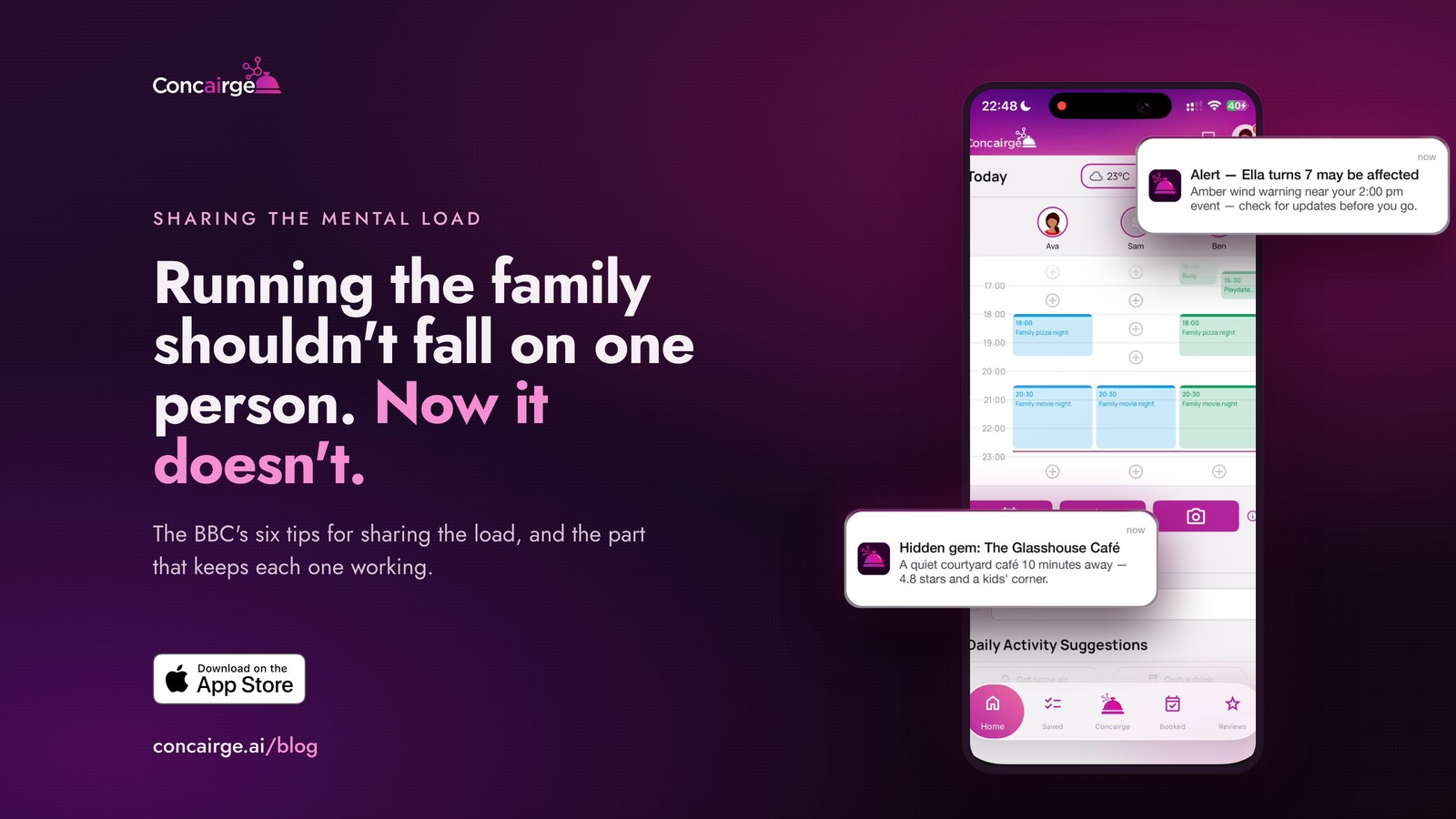
Zach Watson's fix for partners is the fix for tools too. Don't ask "what do you want for dinner?"; come with options, having already looked in the fridge, and give a default. A proactive assistant does exactly that. It turns up with the options before anyone asks: local things the family would actually enjoy, each with a match score, and weekend ideas on Thursday evening. And it watches the plans already on the calendar. When a rail strike, a closure or an amber weather warning is about to hit something the family has booked, it tells you before you find out at the door. When live traffic says the swimming lesson needs an earlier departure, it says so.
What makes it stick: the difference between a calendar and an assistant is who does the anticipating. A calendar keeps whatever one person put in it. An assistant brings what nobody put in, and watches what everyone did. That is the part of the load the study called core, and it is the part a shared calendar leaves exactly where it was.
5. Take ownership from start to finish
Natasha Wallace, a clinical psychologist, told the BBC the goal is to own tasks from start to finish without needing to be reminded. Sam Berry's version is owning "a category of tasks": one parent handles all the school admin, say, while the other does food. Asking what he could do to help, he told the BBC, still left the thinking with the other person.
What makes it stick: the person who owns a category has to be able to see the whole category. Sophia's husband cannot own the school admin from an app he has never opened. When everyone in the household has their own login under one subscription, there is no default parent holding the app. The school emails and the trip dates are on his calendar too, so ownership is a real handover rather than a promise that still routes through someone else's phone.
6. Avoid the efficiency trap
Anita Cleare, a parenting expert, warned the BBC against the "efficiency trap": the belief that the solution is simply to be more organised. She is right, and it is worth saying what that means for an app. No app fixes a relationship, and none fixes a workplace that expects one parent to be permanently reachable. Running the house harder is the wrong goal.
What makes it stick: the point is to stop one brain doing all the anticipating so the family gets that person back. Wallace described the load to the BBC as hundreds of tiny demands that stop the brain switching off. The measure of any change, whether a conversation, a category handover or a piece of software, is whether that person can now switch off.
Kai, one of our founders and a dad of three boys, has written about the week he sent his son to school in the wrong clothes twice. If you are the one carrying the load, this post describes what that feels like. We built Concairge for the gap the BBC's tips leave open. Running the family shouldn't fall on one person. Now it doesn't.
Coordinate the Chaos. Plan the Perfect Day. Discover New Things.
Concairge is on the App Store for iPhone and iPad with a 14-day free trial. Everyone in the household gets their own login, and it connects to Google Calendar and Outlook.